San Diego City Council approves lowering speed limits on 20% of city streets

The San Diego City Council on Monday unanimously passed a resolution to lower speed limits on roughly a fifth of city streets, in order to meet its “Vision Zero” goal to eliminate traffic fatalities and serious injuries.
The strategy, part of the Comprehensive Speed Management Plan approved by the council’s Active Transportation and Infrastructure Committee in February, uses a “data-driven, city-wide approach to lower speed limits across San Diego’s neighborhoods, commercial corridors, and school zones,” according to a city statement.
“Across San Diego, residents consistently tell us they want safer streets in their neighborhoods,” said Councilman and Committee Chair Stephen Whitburn. “Today’s unanimous vote shows that we share that commitment. By aligning our speed limits with safety data and Vision Zero goals, we’re taking an important step toward protecting lives.”
In 2022, the U.S. Department of Transportation awarded San Diego $680,000 through the Safe Streets and Roads for All grant program, intended to bolster Vision Zero efforts to reducing crashes through safer street design, slower speeds, equitable access improvements, and community engagement. One of the initiatives funded was the Comprehensive Speed Management Plan.
The city maintains 3,185 centerline miles — the length of a road sans extra lanes — of public streets, with another 842 under the purview of the city’s engineering and traffic survey network.
State law mandates speed limits posted above 25 mph require an engineering and traffic survey, which entails measuring the 85th percentile speed — essentially the speed most motorists are already traveling. But that process doesn’t account for streets with higher safety risks such as school zones, areas with heavy bicyclist and pedestrian traffic and commercial zones, officials said.
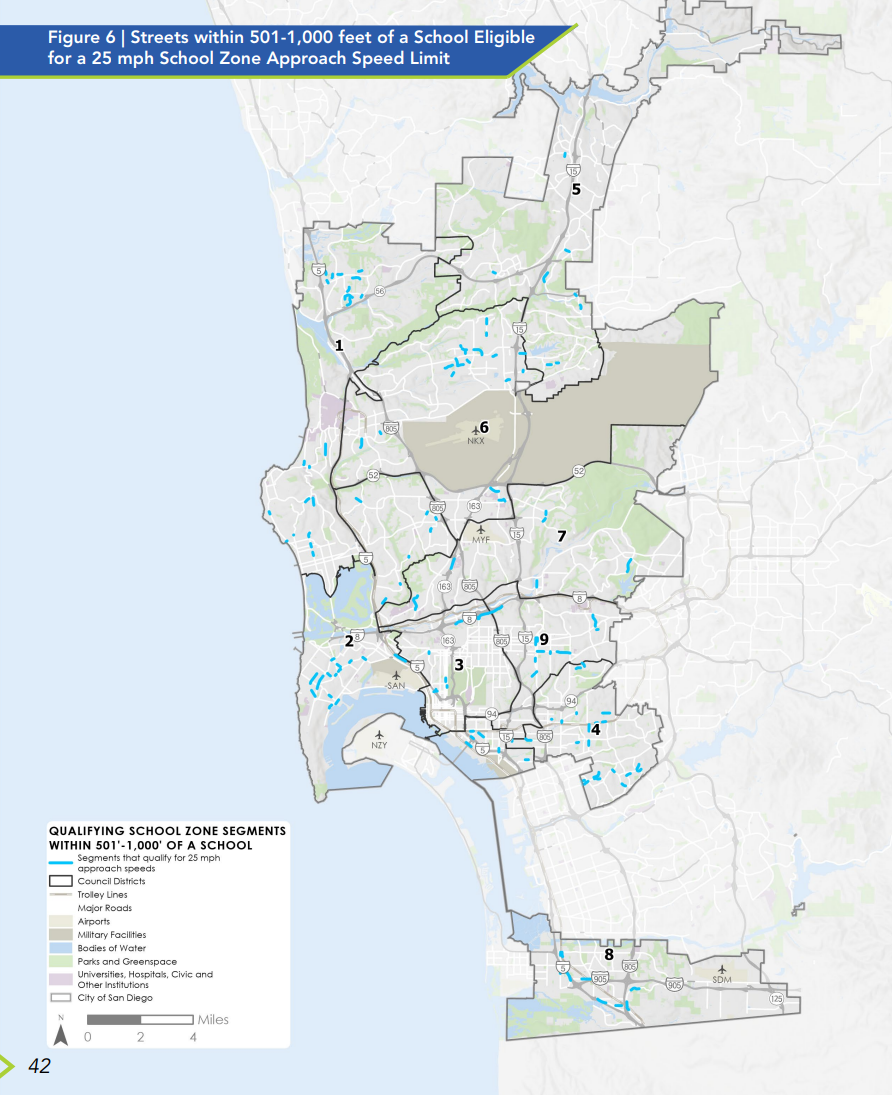
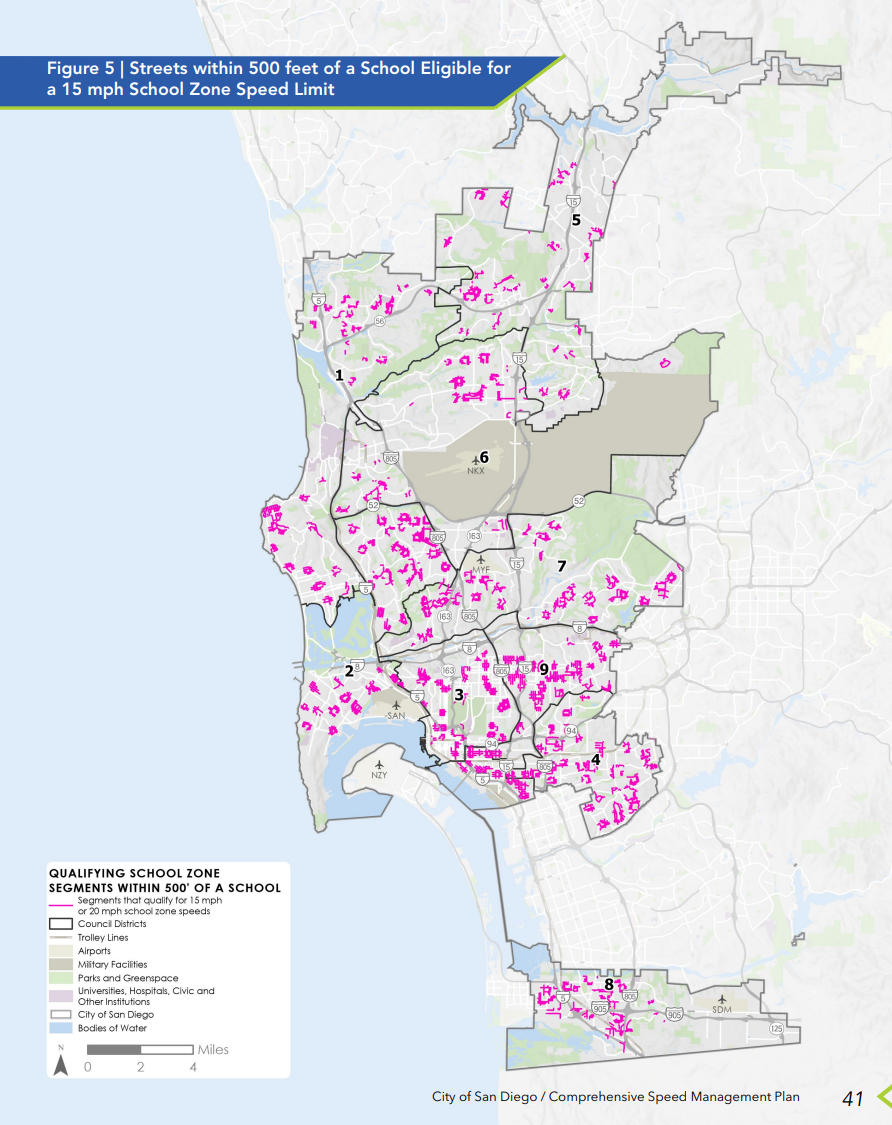
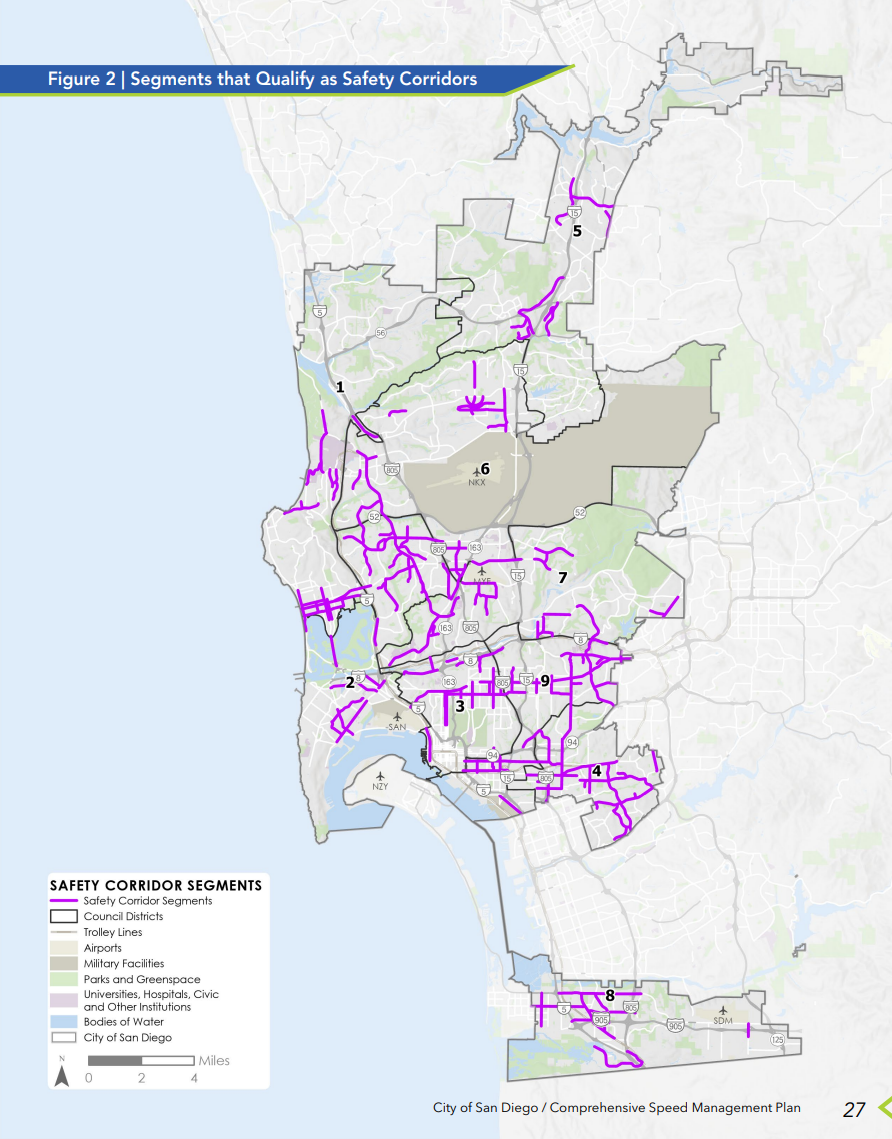
Several new laws passed in Sacramento give cities greater flexibility to determine appropriate speeds rather than defaulting to 25 mph. Corridors with higher comparative fatal or serious injury crashes can see 5 mph reductions, as can areas with high pedestrian and bicyclist activity. Business districts can be reduced to 25 or 20 mph and school zones can reduce speeds to 15 mph or 20 mph within 500 feet of schools, and 25 mph between 501 and 1,000 feet on qualifying nearby approach streets, the city statement read.
With these new permissions from the state, the city found more than 20% of its roads — 679.1 miles — are candidates for slower speeds.
These include:
- 189.6 centerline miles eligible as crash-heavy safety corridors
- 32.6 centerline miles eligible as high a pedestrian and bicyclist activity corridors
- 58.7 centerline miles eligible as business activity districts
- 371.1 centerline miles eligible for school zone speeds (15 or 20 mph)
- 27.1 centerline miles eligible for school approach speeds (25 mph)
“The Comprehensive Speed Management Plan represents a significant step in aligning San Diego’s speed limits with Vision Zero safety priorities,” said Transportation Department Interim Assistant Director Margaret McCormick last month. “The city has a clear and consistent framework to reduce speeds where they will make the most safety impact for all road users.”
Simply lowering speeds will not solve all of the city’s problems, however. Reduced speeds need to be paired with “continued traffic calming improvements, intersection safety enhancements, street design changes, education and public outreach, and traffic enforcement,” to reach Vision Zero, the city statement reads.
“Even 5, 10 miles per hour and reduced speed when a crash occurs can be the difference between walking away or dying,” Aria Grossman with Circulate San Diego said. “Speed limits definitely are not, you know, the one solution to fix all the problems that we’re seeing on our roads, but it’s definitely a good first start.”
Mary Elliot with Families for Safe Streets San Diego lost her husband, Bill, in a biking accident in 2017.
“Those small increments can make a huge difference in saving someone’s life,” Elliot said. “I want to honor my husband for one thing, so it’s anything I can do to support this and save lives is just, you know, it’s so important.”
The plan could go into effect next fiscal year, depending on funding through the city’s annual budget process. Implementation is expected to cost about $2 million, mainly to update signage across the city. Whitburn said roughly 3,000 speed limit signs will have to be changed over the next year.
“The city of San Diego has a real budget problem, and this is about $2.4 million that it will take to implement this, but I can’t think of a better use of money than to save somebody’s life,” the councilman said. “And everybody seems to agree with the fact that reducing speed limits saves lives.”
ake a look at the street that qualify for speed limit reductions in the figures below, or see the list starting on Page 47 of the Comprehensive Speed Management Plan.