
Record highs continue shattering as San Diego County swelters under heat wave

What to Know
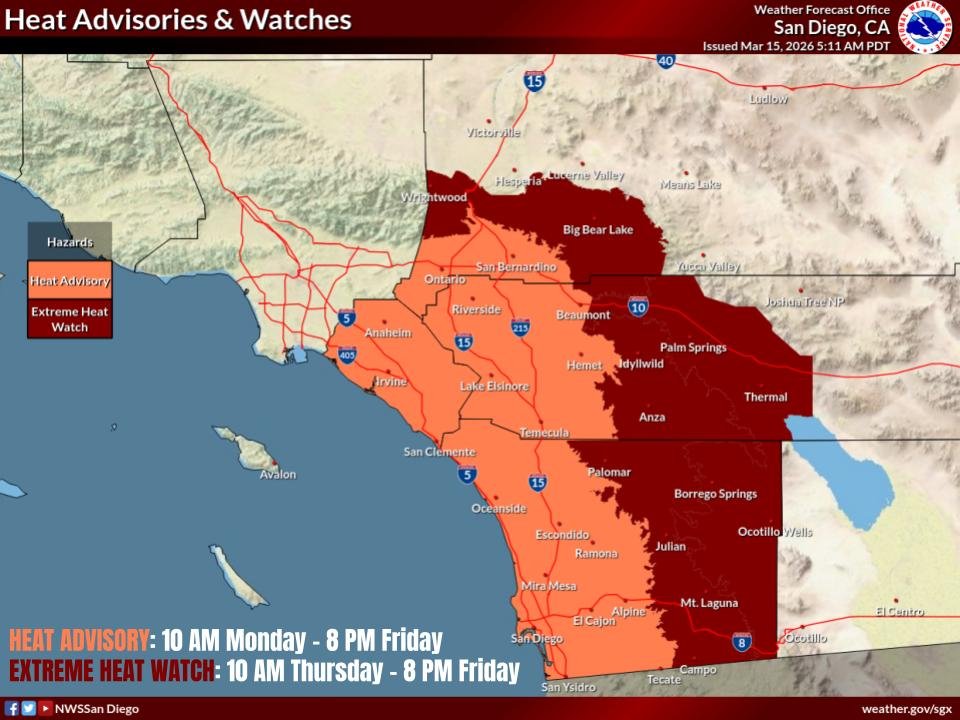
- The National Weather Service issued a Heat Advisory from Monday at 10 a.m. through Friday at 8 p.m. for the coast and valley communities
- An Extreme Heat Watch will also go into effect Thursday morning and last through 8 p.m. Friday for our mountains and deserts
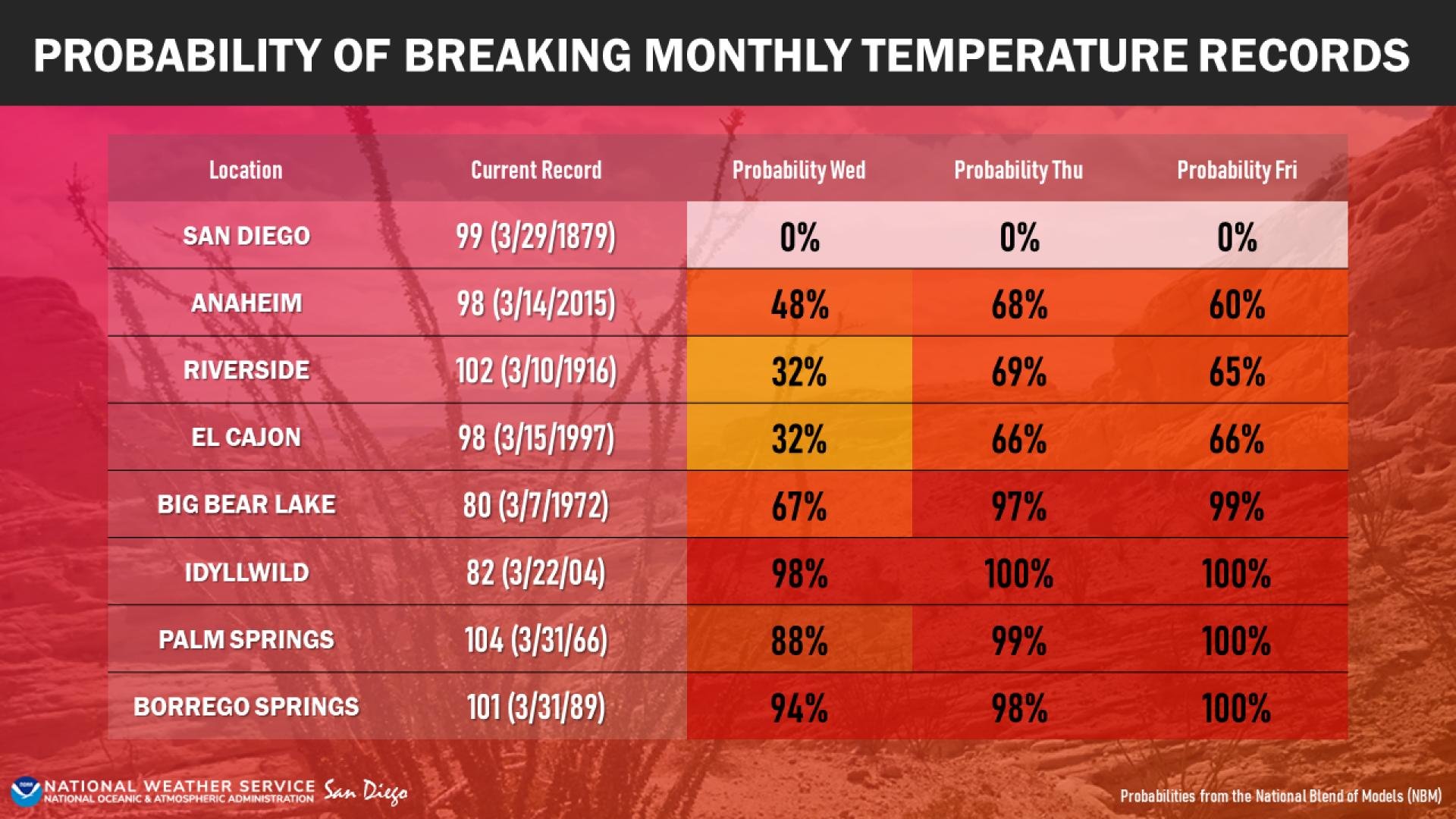
- By the middle of the week, daytime highs could be 20 to 30 degrees above normal, with the likelihood of breaking both daily and monthly records
High temperature records were broken or tied on Tuesday in parts of San Diego County as a heat wave continued to grip the region through Friday.
The National Weather Service issued a heat advisory from 10 a.m. Monday to 8 p.m. Friday for the city of San Diego and the valley areas of San Diego County, the NWS said. An extreme heat watch will take effect at 10 a.m. Thursday until 8 p.m., Friday.
“Not only are temperatures exceptionally warm, given the time of year, but the duration of prolonged heat for widespread locations is what is making this an unprecedented heat wave, especially for this time of year,” said the NWS. “By Thursday, it is possible that there will be a few locations possibly breaking monthly records, and then again on Friday, as temperatures will be at their hottest.”
Temperature records broken or tied on Tuesday (March 17)
Temperatures on Tuesday (St. Patrick’s Day) at San Diego International Airport raised the mercury to 89 degrees, cementing it as the warmest day of the year thus far, according to Meteorologist Greg Bledsoe.
Compared to other March 17 temperatures the NWS keeps on record, several areas around San Diego County broke their records for heat on Tuesday (with one tie). See those below:
- Chula Vista (93) broke their record from 1978
- Ramona (95) broke their record from 2004
- Alpine (96) broke their record from 1978
- El Cajon (97) broke their record from 1978
- Palomar Mountain (79) broke their record from 1972
- Campo (89) tied their record from 2007
Also on Tuesday, Ocotillo Wells was the hottest spot in the entire county at 102 degrees! While the desert is expected to be sweltering, San Pasqual was the hottest spot not in the desert at 99 degrees.
Weather forecast
Temperatures of 80 to 90 degrees are expected near the coast, and 100 to 105 degrees inland.
Coastal temperatures peaked on Tuesday, but it will only be slightly cooler the rest of the week, Bledsoe added.
A weak offshore flow will bring winds of up to 20 mph Sunday through Tuesday. This week, winds will be confined to the usual passes and canyons with peak gusts around 25-35 mph.
“The big story is how this will begin our warming trend as offshore flow combines with the upper level ridge amplifying off the West Coast,” the NWS said.
The agency said Friday is forecast to be the hottest day of the week, with high temperatures around 30 degrees above normal away from the coast, and around 20 degrees above normal at the beaches.
Highs will reach 109-112 degrees in the deserts. An extreme heat warning will go into effect for the deserts starting on Wednesday.
Extended forecast
The heat is sticking around all week, and into the first half of the weekend, Bledsoe said. Temperatures will cool slightly by Sunday and the early part of next week, but it’s still going to be very warm.
Third warmest start to March ever for San Diego
Two and a half weeks into the month, and this is the third warmest start to March ever for San Diego. It’s also tied for the second driest. Technically, San Diego had a trace of rain one morning last week, but less than a hundredth of an inch, Bledsoe said.
Praying for rain? There is no rain anywhere in the extended forecast.
How to keep cool amid heat waves:
County officials offered tips on how people and their families can stay safe:
- Drinking plenty of fluids
- Stay out of the sun
- Wear light, loose-fitting clothing
- Avoid using the oven to cook
- Limit strenuous activities to early morning or evening
- Take refuge in air- conditioned spaces if possible
- Check in on potentially at-risk friends, relatives and neighbors

How to help someone with heatstroke or heat exhaustion:
First and foremost, if you find someone who is suffering from symptoms of heatstroke or heat exhaustion — dizziness, nausea, confusion, headache — call 9-1-1 and start cooling them. DO NOT give them fluids to drink. A person with heatstroke may not be able to swallow. Fluids could run down their trachea into their lungs and make it hard for them to breathe.
After calling 9-1-1, start cooling the person by moving them into the shade, spraying them with cool water and fanning. Place them in a cool shower if they are alert, monitor their body temperatures and continue cooling them.
Unusual triple-digit heat for U.S.
The heat wave on the west coast is shaped from a jet stream that is also creating wild weather across the U.S., including blizzards in the midwest and tornado winds on the east.
Phoenix has only once had a March day that hit 100 and it doesn’t usually start seeing 100 degree days till May, but forecasts are for five straight days of triple-digit temperatures flirting around 107 or higher, meteorologists forecast. The United States hottest March day on record was 108, set in Rio Grande City, Texas, in 1954. There’s a good chance it may be tied or broken, they said.
One weather service forecaster typed in a weather forecast discussion “I audibly gasped” when he looked at forecast temperatures coming out of a computer model.
This will be the type of unusual event that’s studied for years to come like the 2021 Pacific Northwest heat wave, Yale Climate Connections’ Masters said.
This is the type of extreme heat “that you could not get without human-caused climate change,” Masters said. “The extremity is so ridiculous that 50 years ago you would not have seen it.”
Between the heat and a country that’s more than half in drought, Masters said he worries about fires like the one blazing in Nebraska at record levels.
“We’re going to see an early and severe fire season out West,” Masters said.
The Associated Press contributed to this report.


