Rubio scheduled to appear before Senate to outline Trump's Venezuela policy
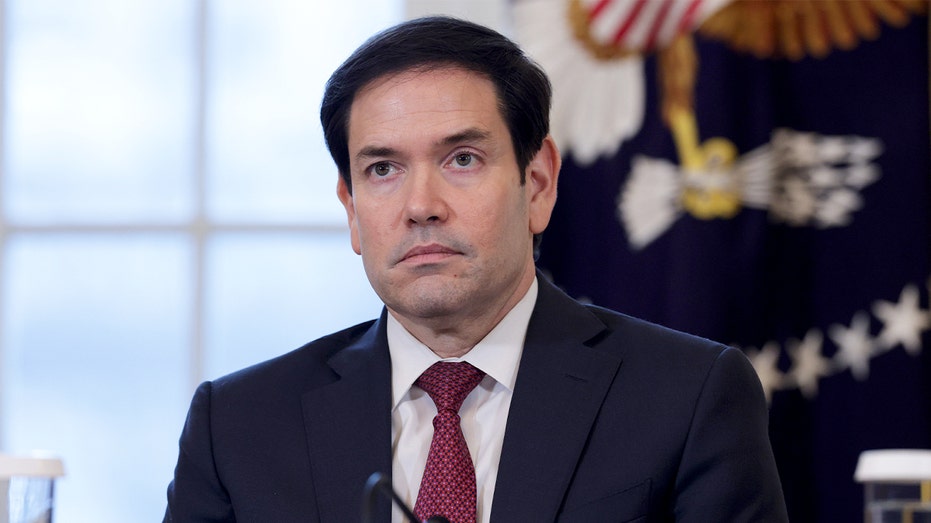
Secretary of State Marco Rubio will publicly testify on the Trump administration’s policy in Venezuela Wednesday morning after vowing to lawmakers that no more military action was expected in the region.
Rubio is expected to tell the Senate Foreign Relations Committee that "there is no war against Venezuela, and we did not occupy a country," according to a copy of his prepared remarks obtained by Fox News.
"There are no U.S. troops on the ground. This was an operation to aid law enforcement," Rubio will say, referring to how U.S. forces captured Nicolás Maduro and his wife, Cilia Flores, earlier this month.
"The United States is prepared to help oversee Venezuela’s transition from a criminal state to a responsible partner," Rubio's prepared remarks state.
He will describe Maduro and Flores as "two indicted fugitives from American justice."
SECRETARY RUBIO SCHEDULED TO FACE FORMER COLLEAGUES ON VENEZUELA POLICY
"Thanks to the leadership of President Trump and the professionalism of the United States Armed Forces, a man who built his power on drugs, corruption and repression will now face justice," Rubio will tell the committee.
The secretary is expected to tell the committee that the U.S. remains ready to use additional force, if necessary. According to his prepared remarks, Rubio assesses that Maduro's successor, interim President Delcy Rodríguez, has stated her intention to cooperate with the U.S. and has "committed to opening Venezuela’s energy sector to American companies, providing preferential access to production, and using revenues to purchase American goods."
Rubio will also say Rodríguez "has pledged to end Venezuela’s oil lifeline to the Cuban regime and to pursue national reconciliation with Venezuelans at home and abroad."
"Rodríguez is well aware of the fate of Maduro; it is our belief that her own self-interest aligns with advancing our key objectives," Rubio's prepared remarks state.
"We will closely monitor the performance of the interim authorities as they cooperate with our stage-based plan to restore stability to Venezuela," the secretary will add. "Make no mistake, as the President has stated, we are prepared to use force to ensure maximum cooperation if other methods fail. It is our hope that this will not prove necessary, but we will never shy away from our duty to the American people and our mission in this Hemisphere."
"The President has made clear that the Western Hemisphere is our home, and we will not tolerate criminality within this Hemisphere that harms American citizens or permit territory to become platforms for our adversaries," Rubio is expected to tell the committee. "Last month the President acted to uphold that principle in Venezuela, and we will continue to do so as is required to keep the American people safe and secure."
Rubio’s return to the Hill, an increasingly frequent occurrence in recent months, comes after he, President Donald Trump, administration officials and Senate Republican leadership successfully killed a bipartisan push to rein in the president’s war authorities in Venezuela.
His scheduled appearance before the Senate Foreign Relations Committee Wednesday at 10 a.m. comes just weeks after he helped to convince two lawmakers, Sens. Todd Young, R-Ind., and Josh Hawley, R-Mo., to flip their votes and back the administration.
Both were concerned about boots on the ground in Venezuela and Congress’ constitutional authority to weigh in on the matter.
They were convinced by Rubio and the administration that no further military action would take place, and that if it were, Trump would come to Congress first.
Young said at the time that the effort, spurred by Sen. Tim Kaine, D-Va., was ultimately just a messaging exercise that never would have survived in the House, nor evaded a veto from Trump.
"I had to accept that this was all a communications exercise," Young said. "I think we [used] this moment to shine a bright light on Congress' shortcomings as it relates to war powers in recent history."
RUBIO LAYS OUT THREE-PHASE PLAN FOR VENEZUELA AFTER MADURO: 'NOT JUST WINGING IT'
Rubio also wrote to Senate Foreign Relations Chair James Risch, R-Idaho, to spell out that the administration would clue in Congress should any future military action take place in the region.
"Should there be any new military operations that introduce U.S. Armed Forces into hostilities, they will be undertaken consistent with the Constitution of the United States, and we will transmit written notifications consistent with section 4(a) of the War Powers Resolution (Public Law 93-148)," he said.
However, Rubio’s appearance before the panel comes on the heels of unrest stateside following another fatal shooting in Minnesota, where Alex Pretti was killed in the midst of a Department of Homeland Security-led immigration operation in Minneapolis.
KAINE VOWS NEW WAR POWERS FIGHTS AFTER SENATE BLOCKS TRUMP VENEZUELA CHECK
While he won’t have to answer for that situation, it has drastically shifted the Senate’s attention over the last several days.
It also follows Kaine’s vow to file several more war powers resolutions against Trump, specifically against action in Greenland, Iran and elsewhere.
Kaine believed that he could take advantage of cracks that formed in Republicans' unified front earlier this month, when five joined all Senate Democrats to advance his resolution to require any future military action in Venezuela would need Congress’ approval.
"The way cracks grow is through pressure and the pressure campaign that I sort of decided to launch by use of these privileged motions," Kaine said after his initial push failed.
"I'm going to file every one I can to challenge emergencies, to challenge unlawful wars, to seek human rights reports, arms transfers if they're wrong," he continued.