
Ancient sanctuary tied to 'most mysterious' cult uncovered in rare find beneath historic city
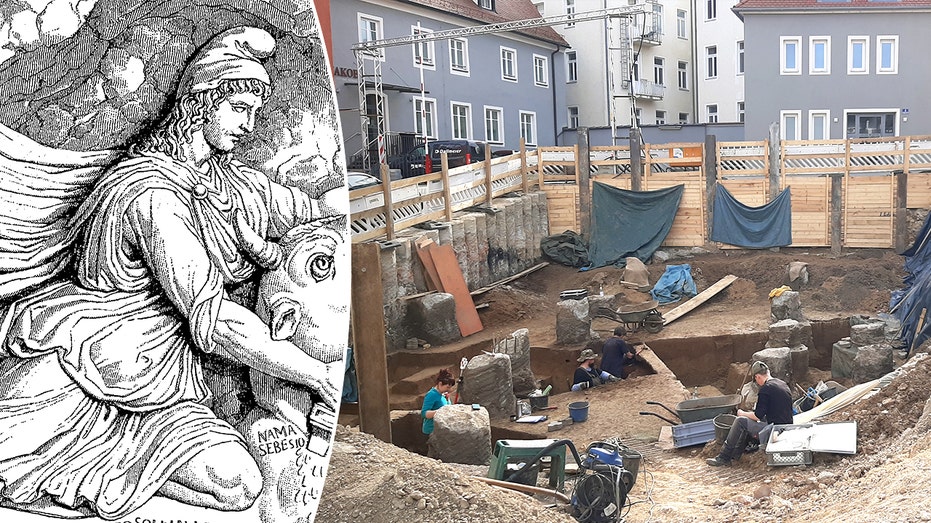
A rare Roman temple tied to a secretive cult has been unearthed in Germany — the oldest-known sanctuary of its kind in Bavaria.
Its remnants were found ahead of a construction project involving multistory apartment buildings in Regensburg, officials said.
The City of Regensburg announced the discovery in early February.
ANCIENT CHRISTIANS LIVED ALONGSIDE FOLLOWERS OF MYSTERIOUS FAITH 1,500 YEARS AGO, ARCHAEOLOGISTS SAY
The temple, built sometime during the first or second centuries A.D., was dedicated to Mithras, a deity from a "mystery cult" associated with light and cosmic order.
Mithraism spread widely across the Roman Empire in the second and third centuries A.D. — and existed alongside early Christianity.
The discovery is "in fact, very rare," said Johannes Sebrich, an archaeologist with the City of Regensburg.
The official told Fox News Digital in a translated email that the find is "also unique in Bavaria."
Sebrich noted, "Based on the evaluation of the coins discovered in the sanctuary, it is the oldest of the nine known Mithras temples identified in Bavaria to date."
He said the Mithras cult spread from Asia Minor to Rome through cultural exchange. "Secret knowledge" was passed on to mystae — members of the cult — during rituals.
TEST YOURSELF WITH OUR LATEST LIFESTYLE QUIZ
"As their knowledge increased, they could attain up to seven grades of initiation and thus ascend the celestial ladder toward the highest possible level of understanding," Sebrich said.
"It can be described as a ‘star cult’ or ‘mystery cult,’ and is regarded to this day as the most fascinating — yet still most mysterious — cult of the Roman gods."
These rituals were documented in Regensburg, and the site contained drinking vessels, tableware and storage containers.
"Animal bones found in ritual or refuse pits attest to the high quality of the food that was sacrificed and/or consumed," the archaeologist noted.
CLICK HERE TO SIGN UP FOR OUR LIFESTYLE NEWSLETTER
Archaeologists didn't realize the significance of the building until the post-excavation analysis, Sebrich said.
Though no cult image turned up during the early part of the excavation, Sebrich said "the special tableware, the overturned cabinet and the distinctive food remains provided numerous indications that it was a Mithraeum."
Later, archaeologists uncovered a silver votive plaque reading "DEO INVICTO" — a title only used for Mithras.
Only "selected individuals" could become members of the cult, Sebrich said, though it wasn't necessarily restricted by social class.
CLICK HERE FOR MORE LIFESTYLE STORIES
"In addition to soldiers, members included veterans, merchants, slaves and freedmen," he noted. "Women were generally excluded from membership."
The cult eventually died out by the 5th century as Christianity became the dominant religion of the Roman Empire, according to numerous sources.
Sebrich said the temple burned down in 171 A.D., as part of the Marcomannic Wars.
"The Mithraeum was not rebuilt afterward, even though in the following years — with the establishment of the legionary camp in A.D. 179 by Emperor Marcus Aurelius — the civilian settlement was re-founded on a much larger scale," he said.
He added, "It is possible that undamaged altars or cult objects were salvaged from the fire debris and reused in the new sanctuaries."